


Introduction
In the air management system of a heavy truck, the air compressor pipe carries the high-pressure air generated by the compressor to the reservoir and downstream treatment units. Although this pipe does not directly participate in braking or suspension actuation, its integrity determines the air supply efficiency of the entire pneumatic system. Once the pipe develops a leak, a loose connection, or a crack in the tube body, the compressor will continue running without being able to build sufficient pressure-braking system performance declines, suspension fails to operate normally, and the vehicle is forced out of service.
OEM number 22035751 identifies an air compressor pipe that is standard equipment in the air systems of Volvo FH, FM, FMX, and NH series trucks, covering 9, 10, 11, 12, 13, and 16-liter engine platforms. The pipe circulates in the aftermarket as both new aftermarket parts and used salvaged parts, primarily serving models such as the Volvo FM11, with associated references including 21641842 and 21331636.
For aftermarket distributors, import companies, and workshop chains serving Volvo fleets, the 22035751 is a category with genuine demand, clear failure consequences, and aftermarket supply dominated by salvaged parts. This article examines the compressor pipe from an aftermarket perspective, covering its technical function, application scope, quality differentiation criteria for aftermarket parts, and how distributors can build a supply relationship around this component.
I. Technical Function and Failure Modes
The core function of an air compressor pipe is to establish a reliable high-pressure airtight connection between the compressor outlet and the reservoir (or air treatment unit). For heavy trucks like the Volvo FH/FM, the compressor must continuously supply air to the braking system, suspension system, clutch assistance, and auxiliary pneumatic equipment. The pipe operates at pressures typically ranging from 8-12 bar, accompanied by pressure pulsations generated by the compressor's cyclic loading and unloading.
The 22035751 is a formed metal pipe whose geometry is specifically designed to match the compressor mounting position and reservoir layout on Volvo truck chassis. According to aftermarket data, associated references 21641842 and 21331636 appear alongside 22035751 in cross-references, possibly indicating variants within the same component family or a companion relationship. The component primarily serves Volvo FH/FM/FMX/NH 9/10/11/12/13/16 series, with the FM11 explicitly identified as a compatible model.
Air compressor pipe failure typically manifests in the following modes:
Connection leakage: The junctions between the pipe and the compressor outlet or reservoir inlet are sealing weak points. Aged ferrules, worn cone surfaces, or improper installation torque can cause high-pressure air to leak slowly at connections. This failure is often not immediately apparent until the compressor loads frequently or system pressure becomes insufficient.
Corrosion perforation: Metal pipes continuously exposed to road splash, salt, and moisture gradually corrode on the outer wall. Once perforation occurs, high-pressure air escapes directly, and the compressor cannot maintain system pressure even with continuous operation. This is one of the most common failure modes in high-age vehicles.
Vibration fatigue cracking: Under repeated compressor vibration and chassis movement, the pipe may develop fatigue cracks at fixation points or bends. Such failures often occur suddenly, and the location is concealed, making diagnosis difficult.
Fixation failure: Loose or broken pipe clamps or brackets cause the pipe to shift and rub against adjacent components, eventually wearing through the pipe wall or damaging connections.
For aftermarket distributors, compressor pipe replacement demand is driven by two scenarios: replacement after leakage or corrosion is identified during vehicle repair or inspection, and replacement after accident damage to chassis piping. The former is relatively dispersed but continuous; the latter is sudden.
II. Application Scope and Aftermarket Supply Landscape
The application coverage of 22035751 centers on the Volvo FH/FM/FMX/NH series, covering 9-liter to 16-liter engine platforms, with the FM11 explicitly identified in aftermarket data as a compatible model. This coverage means the pipe serves several of the highest-volume series in Volvo's heavy truck lineup, with a substantial installed base.
In the aftermarket, the supply landscape for 22035751 has a notable characteristic: used salvaged parts dominate. Multiple European salvaged-part suppliers offer used original pipes at relatively low prices, with products typically indicating the source vehicle's model and year. New aftermarket supply is relatively limited, creating a clear market space for aftermarket manufacturers with metal pipe forming and fitting machining capabilities.
From a distributor's perspective, this supply landscape means two things. First, price and quality stratification is pronounced: used parts are lower-priced but of uncertain condition and remaining life, while new aftermarket parts are higher-priced but offer quality assurance. Second, supply stability requires manufacturing partner support: distributors relying on salvaged sources face unpredictable inventory, while stable new aftermarket supply requires a reliable manufacturing source.
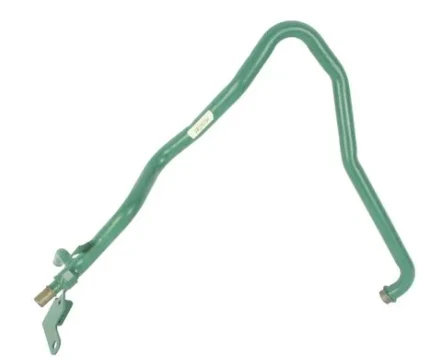
In terms of cross-references, 21641842 and 21331636 are the primary numbers associated with 22035751. Distributors should be able to recognize the correspondence between these numbers when stocking and handling customer inquiries, so that fitment can be quickly confirmed when a customer provides a different reference number.
III. Quality Differentiation Criteria for Aftermarket Compressor Pipes
Compressor pipes may appear simple, but quality differences between aftermarket parts directly affect air supply reliability and service life. When evaluating supply sources, distributors should focus on the following technical dimensions.
Tube material specification and pressure resistance: Compressor pipes must withstand continuous operating pressures of 8-12 bar plus pressure pulsation over extended periods. Quality aftermarket parts should use steel or aluminum tubing comparable to OE specification, with uniform wall thickness capable of passing burst pressure testing. Pipes with insufficient wall thickness or material strength may expand, deform, or crack under pressure pulsation.
Fitting precision and sealing surface quality: The fittings at both ends of the pipe are critical to sealing. The cone angle, thread precision, and surface finish of the fittings must match Volvo original specifications. Pipes with insufficient fitting precision may leak after installation even when tightened properly, due to poor sealing surface contact. Some low-cost aftermarket products simplify fitting machining, resulting in the need for repeated tightening or seal replacement after installation.
Corrosion protection: Compressor pipes are located under the chassis, exposed to moisture and salt. Quality aftermarket parts should have appropriate anti-corrosion coatings (such as galvanizing, powder coating, or aluminizing) to maintain corrosion resistance in salt-spray environments. Pipes with insufficient corrosion protection may develop external rust within two to three years, shortening the replacement cycle.
Geometric precision and fitment: The bend angles, length, and fixation point locations of the pipe must match the original pipe. Geometric deviations cause interference with adjacent components during installation, or misalignment of fixing clamps, leading to vibration and wear. Aftermarket parts differ significantly in how these details are handled, and low-cost products often compromise on forming precision.
Batch consistency: For distributors, batch consistency means pipes from different production runs maintain consistent dimensions and material performance. Reliable aftermarket manufacturers should provide batch traceability records and have corrective capability when quality issues arise.
IV. Positioning This Component for Aftermarket Distributors
For distributors building or expanding a Volvo air system aftermarket product line, the 22035751 has several clear positioning characteristics.
Genuine demand but limited supply options: Compressor pipe replacement demand is driven by leakage, corrosion, and accident damage-genuine needs in Volvo FH/FM fleet aftermarket service. However, the current market is dominated by used salvaged parts, with limited new aftermarket supply channels. Distributors who can provide stable new aftermarket parts have a differentiation advantage in this category.
Synergy with air system category: Compressor pipes can form a product combination with air compressors, dryers, reservoirs, valves, and fittings, offering workshops a one-stop solution for air system repair. This category strategy creates more customer stickiness than single-SKU sales and better demonstrates the distributor's depth of understanding of Volvo air systems.
Urgency-driven sales: When a workshop identifies compressor pipe leakage causing insufficient brake system pressure, the vehicle is in a non-deliverable state, and the workshop needs a replacement the same day. Distributors who maintain inventory have a structural advantage in these sales, and the uncertainty of salvaged sources highlights the value of stable supply.
Technical support as a differentiator: Compressor pipe installation involves fitting torque specifications and fixation point alignment. Distributors who can provide installation precautions, fitting seal recommendations, and fitment confirmation build technical value with workshop customers that goes beyond price competition.
V. Partnering with Mide-Diesel for Aftermarket Compressor Pipe Supply
For distributors and import companies seeking a factory-direct aftermarket supply of compressor pipes and related air system components, Mide-Diesel Technology & Parts Co., Ltd. offers a manufacturing partnership built on production capability and aftermarket focus.
Founded in 2009 and headquartered in Shanghai, Mide-Diesel has developed multi-category manufacturing capabilities across the European heavy truck aftermarket parts sector, supplying distributors and workshop customers in more than fifty countries and regions. The company's product range encompasses aftermarket components for multiple Volvo truck systems, with metal pipe forming and fitting machining capabilities enabling the supply of compressor pipes compatible with Volvo FH/FM/FMX platforms.
On the production side, Mide-Diesel follows full-process quality control from raw material inspection through finished product functional verification. Compressor pipe products undergo dimensional precision, fitting sealing surface quality, and corrosion protection checks before shipment, ensuring batch consistency meets professional aftermarket requirements.
For distributors seeking to move from sporadic purchasing to scalable wholesale relationships, Mide-Diesel provides bulk inventory support, enabling partners to build their own branded air system component lines. A dedicated after-sales technical support team assists with cross-reference confirmation and fitment inquiries.
Distributors already sourcing other Volvo aftermarket categories from Mide-Diesel-including transmission control components, cooling system parts, or engine electrical components-can typically incorporate compressor pipes into their existing supply relationship without the overhead of qualifying an entirely new supplier.
Conclusion
The air compressor pipe (OEM 22035751) is a functionally critical but supply-limited component in the air systems of Volvo FH/FM/FMX/NH trucks. Its demand is genuine and failure consequences are clear, while the current market is dominated by used salvaged parts of uncertain condition, with stable new aftermarket supply channels relatively scarce. For aftermarket distributors serving Volvo fleets, this category is both a challenge and an opportunity-distributors who can provide consistently quality, accurately fitting new aftermarket parts will build a reputation for reliable supply among workshop customers.
In the aftermarket context, success depends not on chasing the lowest price or relying on salvaged sources, but on identifying manufacturing partners who can provide consistent quality, reliable delivery, and clear warranty coverage. Building an air system product line around a verified aftermarket supplier is the practical path to earning long-term workshop trust.


